High Resolution UDF Meshing via Iterative Networks
Paper accepted to NeurIPS 2025
Federico Stella, Nicolas Talabot, Hieu Le, Pascal Fua


Feel free to contact us for any questions!
Abstract
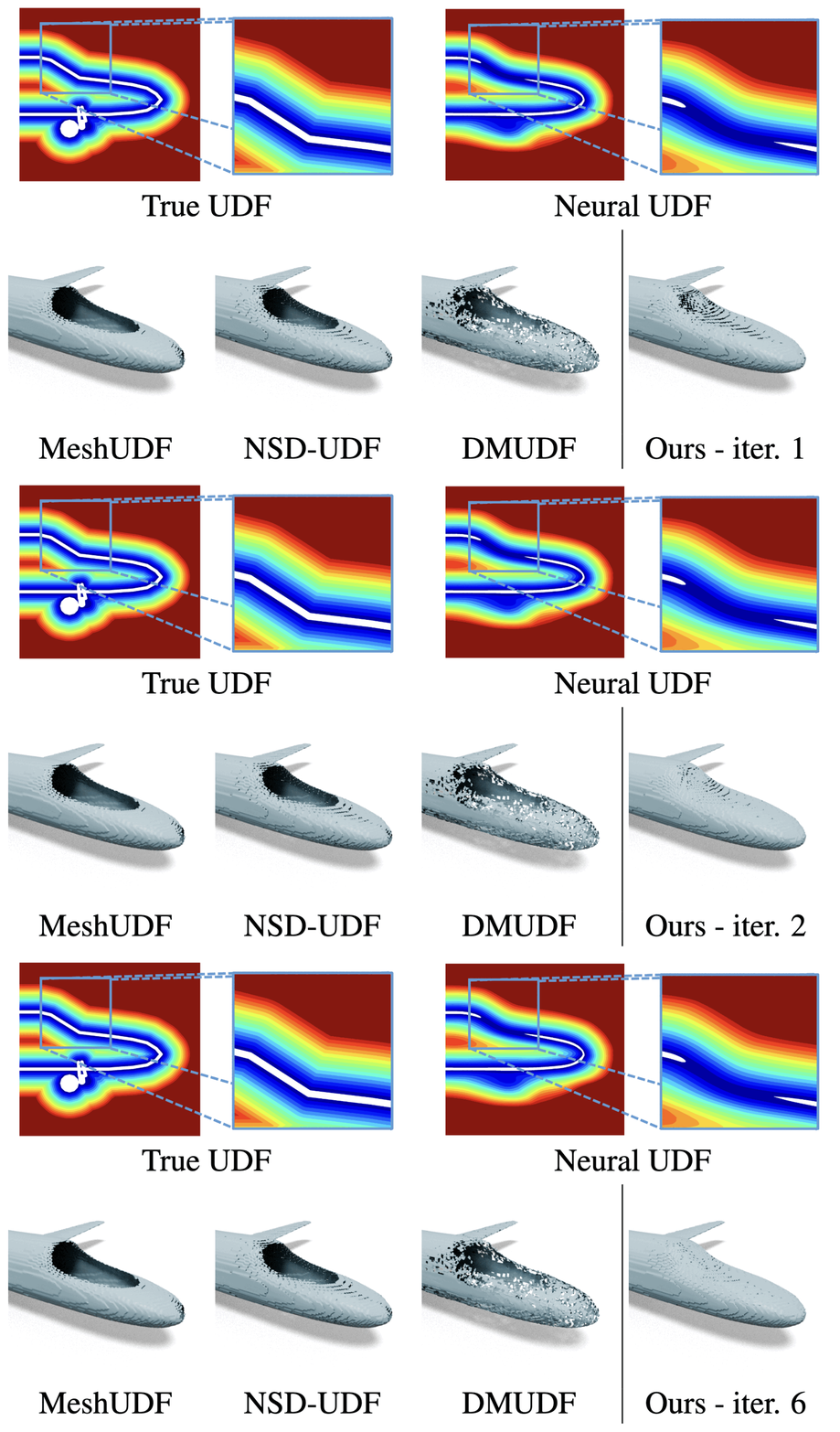
Unsigned Distance Fields (UDFs) are a natural implicit representation for open surfaces but, unlike Signed Distance Fields (SDFs), are challenging to triangulate into explicit meshes. This is especially true at high resolutions where neural UDFs exhibit higher noise levels, which makes it hard to capture fine details. Most current techniques perform within single voxels without reference to their neighborhood, resulting in missing surface and holes where the UDF is ambiguous or noisy. We show that this can be remedied by performing several passes and by reasoning on previously extracted surface elements to incorporate neighborhood information. Our key contribution is an iterative neural network that does this and progressively improves surface recovery within each voxel by spatially propagating information from increasingly distant neighbors. Unlike single-pass methods, our approach integrates newly detected surfaces, distance values, and gradients across multiple iterations, effectively correcting errors and stabilizing extraction in challenging regions. Experiments on diverse 3D models demonstrate that our method produces significantly more accurate and complete meshes than existing approaches, particularly for complex geometries, enabling UDF surface extraction at higher resolutions where traditional methods fail.The problem
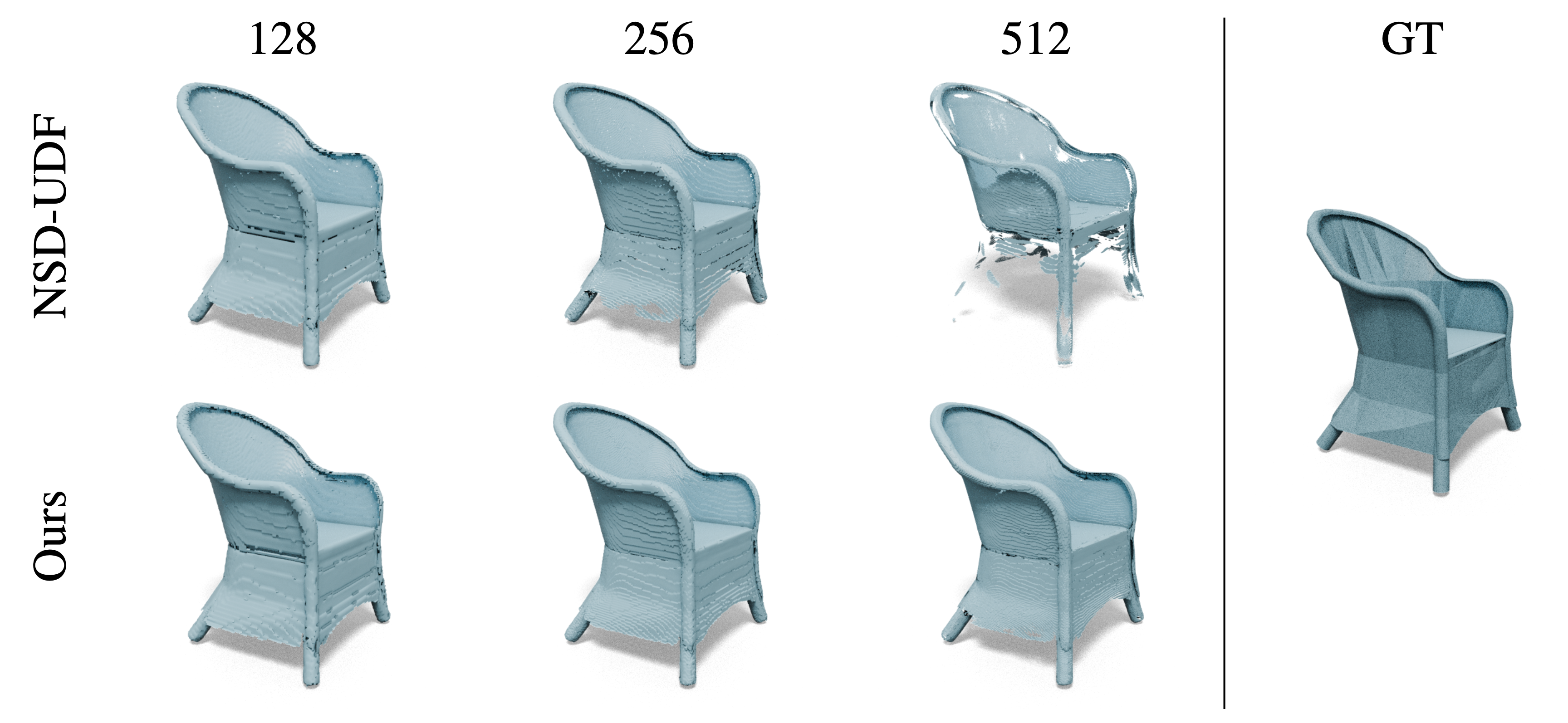
Neural UDFs are noisy and difficult to mesh. Counterintuitively, meshing at higher resolutions worsens the problem, with existing methods often missing entire portions of the surface.
Our pipeline

We formulate high-resolution meshing as an iterative process: each iteration takes the previous output state as input and refines it.
An iterative improvement
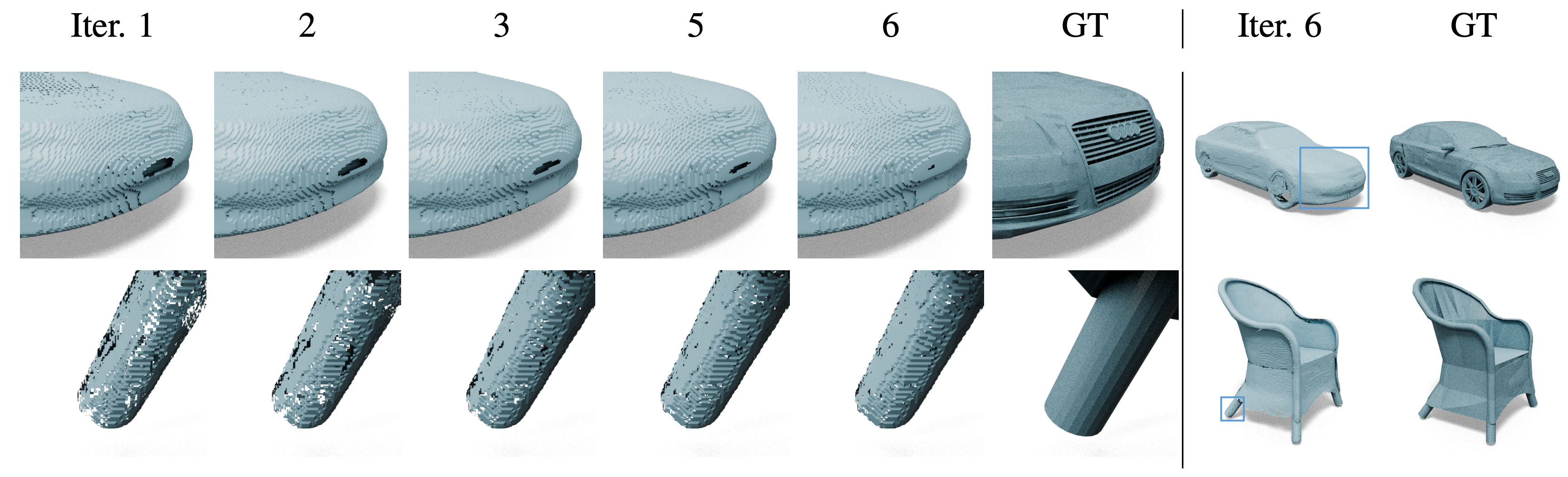
The mesh is improved over multiple iterations, where each step integrates newly detected surfaces, distance values, and gradients from neighboring cells.
The result
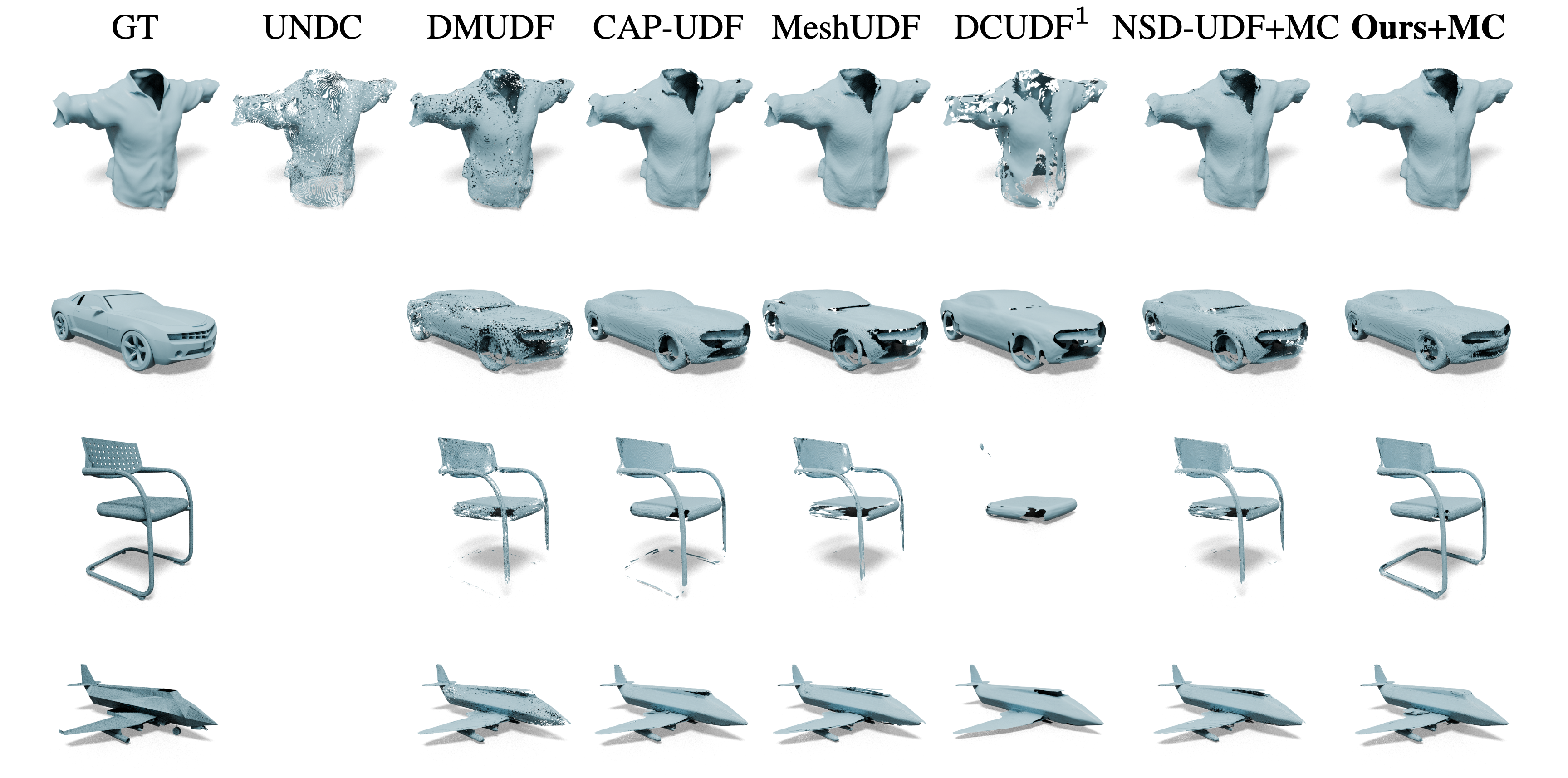
While still being far from perfect, we obtain state of the art results across multiple datasets and with multiple different UDF backbones.
BibTeX
If you find our work useful, please cite it:
@misc{stella2025hrudf,
      title={High Resolution UDF Meshing via Iterative Networks},
      author={Federico Stella and Nicolas Talabot and Hieu Le and Pascal Fua},
      year={2025},
      eprint={2509.17212},
      archivePrefix={arXiv},
      primaryClass={cs.GR},
      url={https://arxiv.org/abs/2509.17212},
}